TIKTOK SHOP: REVOLUTIONIZING CUSTOMER EXPERIENCE MANAGEMENT IN MODERN E-COMMERCE
TIKTOK SHOP: REVOLUTIONIZING CUSTOMER EXPERIENCE MANAGEMENT IN MODERN E-COMMERCE
By: Dominika Zdun, Gabriela Zimak, Magdalena Gałek
1. Introduction: The Evolution of Customer Experience
The digital marketplace is currently undergoing a profound transformation. For years, the gold standard of online retail was defined by search-driven platforms. A customer recognized a need, navigated to a classic e-commerce platform, searched for a product, and made a purchase. The focus of businesses during this era was primarily on Service Quality—ensuring the website was fast, the search algorithm was accurate, and the checkout process was secure. However, as the digital landscape has evolved, so have consumer expectations. Modern shoppers no longer seek just a transaction; they demand an engaging, seamless, and entertaining journey. This shift marks the transition from basic Service Quality to holistic Customer Experience (CX) Management.
Within this new paradigm, ‘Shoppertainment’—the intersection of entertainment and commerce—has emerged as the dominant strategy for modern, fast-growing retail organizations. At the absolute forefront of this revolution is TikTok, a platform that has transformed from a simple short-form video sharing app into a global commercial powerhouse. The introduction of TikTok Shop, particularly its rollout in markets like Poland, represents a critical case study in modern Customer Experience Management. It fundamentally rewrites the rules of how brands interact with consumers, how trust is established, and how the traditional sales funnel is compressed into a matter of seconds.
This comprehensive report explores the phenomenon of TikTok Shop in the context of Customer Experience Management. It analyzes how the platform’s native integration, reliance on influencer marketing, and live commerce capabilities create a uniquely frictionless environment that stands in stark contrast to classical e-commerce platforms like Amazon or Allegro. By examining the operational and psychological mechanics of TikTok Shop, we can extract vital lessons for future CX managers aiming to build customer satisfaction in a highly competitive, omnichannel world.
2. Understanding TikTok Shop: A Native E-Commerce Ecosystem
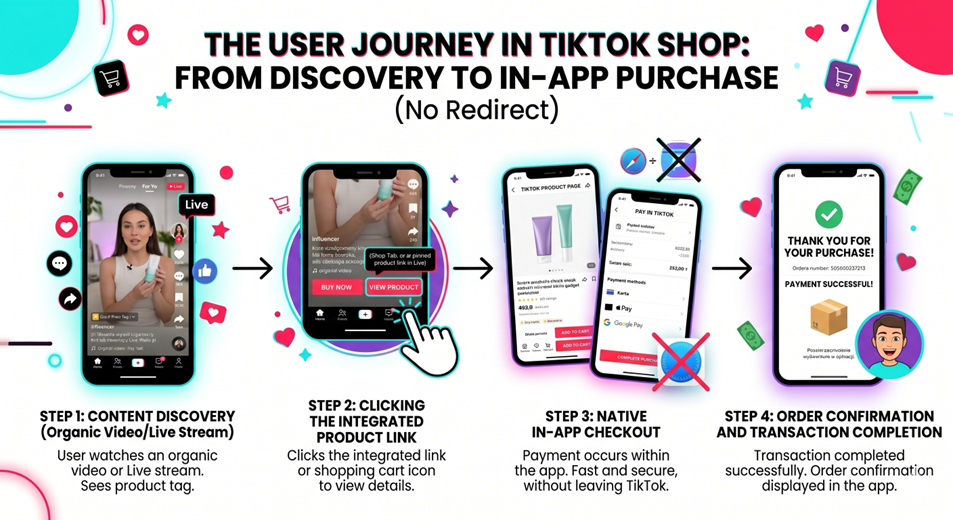
To evaluate the impact of TikTok Shop on Customer Experience, one must first understand its structural architecture. As noted by industry experts and prominent CX blogs, TikTok Shop in Poland is not merely an external link embedded in a video profile. It is a fully native feature built directly into the TikTok application. It enables creators and brands to sell products without ever forcing the user to leave the platform. This single architectural decision is perhaps the most significant CX innovation in recent digital retail history.
TikTok Shop essentially amalgamates several distinct commercial features into one cohesive ecosystem. It combines the vast product variety of a traditional marketplace, the immediacy of direct purchasing systems (thanks to integrated internal payment gateways), the interactive nature of live-stream commerce, and the persuasive power of influencer marketing. When a user watches a video reviewing a cosmetic product, a small, unobtrusive shopping bag icon appears on the screen. Tapping this icon does not open a new browser window—it opens a native product page directly over the video, allowing the user to select variants, apply coupons, and authorize payment (e.g., via Apple Pay, Google Pay, or localized methods like BLIK) in seconds.
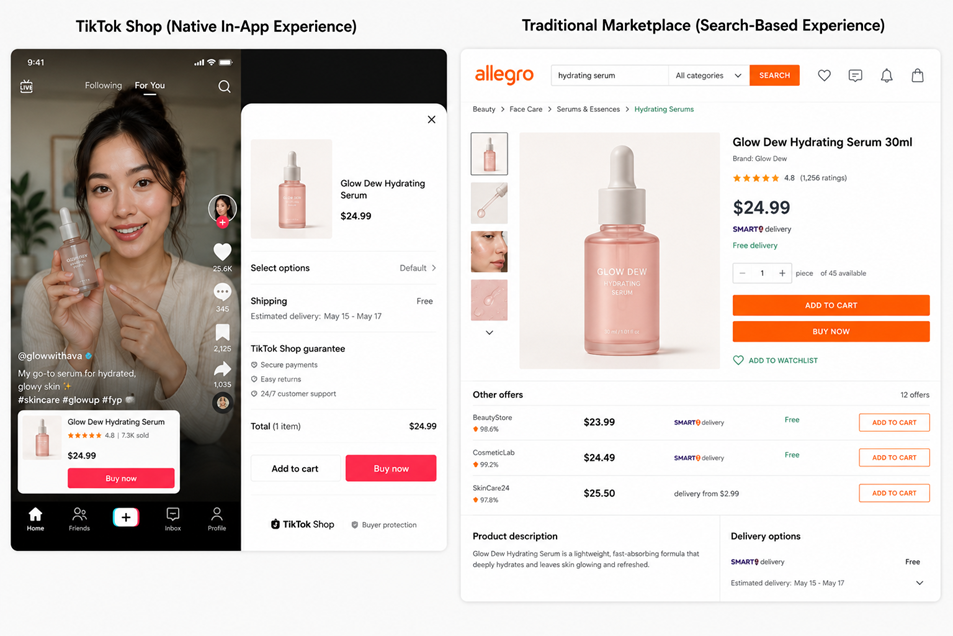
This contrasts sharply with the classic e-commerce experience provided by giants like Allegro or Amazon. On those platforms, the customer journey is highly intentional but often lacks emotional engagement. The user is presented with a sterile grid of products, standardized white backgrounds, and text-heavy descriptions. The cognitive load required to read reviews, compare prices, and finalize the checkout is relatively high. TikTok Shop flips this model. The product discovery is passive and driven by a highly personalized algorithm. The content is emotionally engaging and visually stimulating. By the time the user makes a purchasing decision, the emotional connection has already been established, and the operational friction of buying is practically zero.
3. The Power of Frictionless Customer Experience
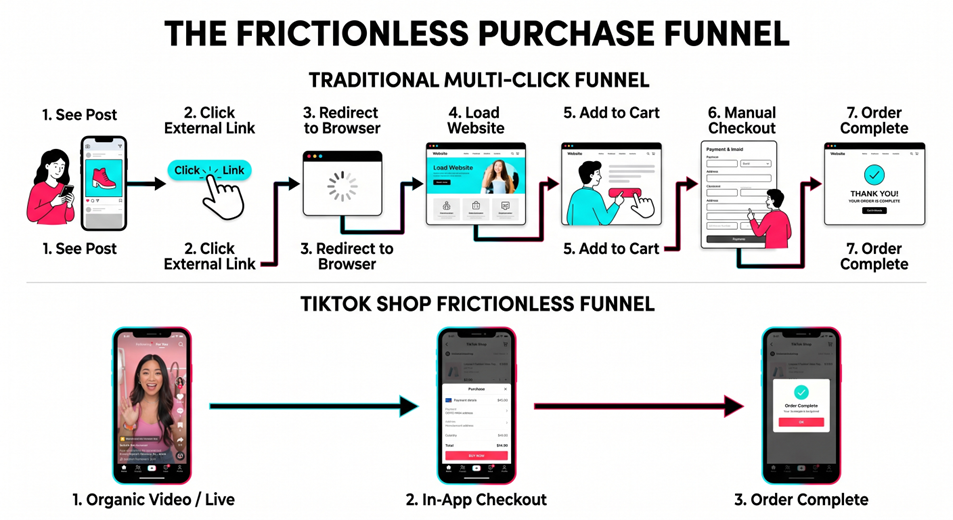
In Customer Experience Management, ‘friction’ refers to any obstacle, delay, or cognitive burden a customer faces during their journey. Friction is the enemy of conversion. Traditional digital marketing often involves a multi-step funnel: a user sees an ad on social media, clicks a link, waits for a website to load, navigates a mobile site, adds an item to a cart, creates an account, inputs shipping details, and finally pays. At every single step of this process, there is a statistically significant drop-off rate as users lose interest, get distracted, or become frustrated by poor User Interface (UI) design.
TikTok Shop achieves what CX managers call a ‘Frictionless Experience’. Because the payment and shipping details are often pre-saved within the user’s TikTok profile, the journey from product discovery to transaction completion can literally take three taps. This seamlessness is not just a technological convenience; it fundamentally alters consumer psychology. It transforms buying from a planned, logical task into a spontaneous, emotionally driven action.
Furthermore, this frictionless environment extends to the post-purchase phase. Customer Experience does not end when the payment is processed. Modern retail organizations must manage order tracking, customer support, and returns. TikTok Shop integrates order management directly into the user’s social inbox. Notifications about shipping updates appear right next to messages from friends and alerts about new video likes. This normalizes the commercial aspect of the app, blending it perfectly with the user’s daily social interactions and maintaining high customer satisfaction.
4. Influencer Marketing: Building Trust and Authenticity
A cornerstone of TikTok Shop’s success—and a critical element of modern CX strategy—is its deep integration with influencer marketing. In traditional commerce, trust is built through brand reputation, professional photography, and cumulative star ratings. In the social commerce era, trust is built through parasocial relationships between consumers and content creators.
TikTok’s affiliate system allows everyday creators to attach product links directly to their videos. Unlike highly polished, high-budget TV commercials, TikTok content thrives on authenticity and raw aesthetic. A creator filming a review in their bedroom, showing the actual texture of a skincare product or the fit of a piece of clothing, provides a level of tangible assurance that a studio photograph simply cannot match. This authenticity drastically improves the Customer Experience because the buyer feels they are receiving a genuine recommendation from a peer rather than a corporate sales pitch.
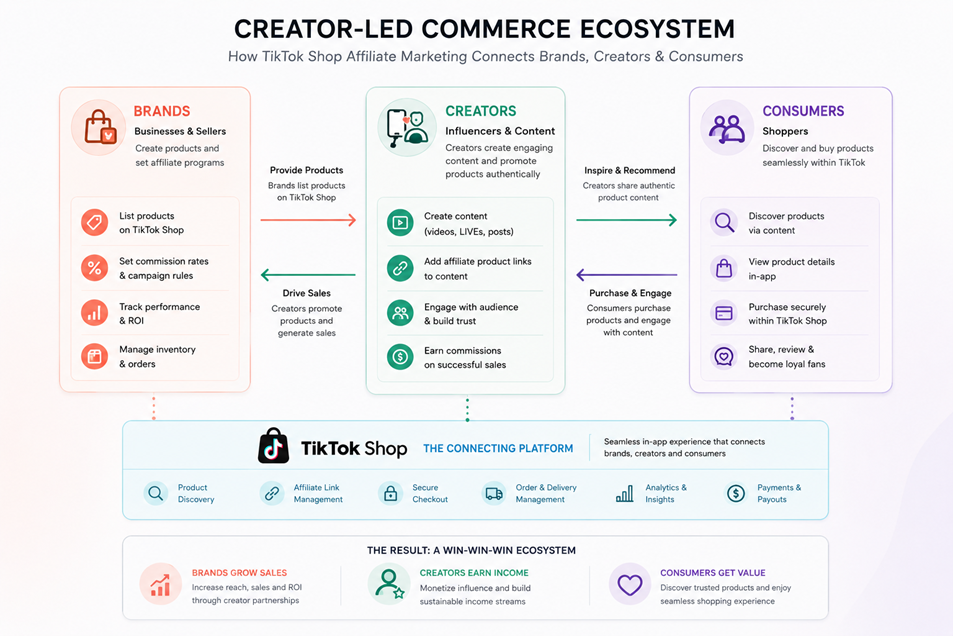
For a Customer Experience Manager, leveraging this ecosystem means relinquishing some degree of strict corporate control over brand messaging. Instead of dictating exactly how a product should be presented, brands must empower creators to interpret the product in a way that resonates with their specific niche audience. This requires a paradigm shift: the creator is not just an advertiser; they are an extension of the brand’s customer service and CX team. When a creator actively responds to comments on their video, answering specific questions about the product’s sizing or material, they are performing real-time, highly personalized customer service.
5. Live Commerce: Real-Time Customer Engagement
One of the most dynamic features of TikTok Shop, and a major focal point for CX professionals, is Live Commerce (Live Shopping). While live shopping has roots in traditional television networks like QVC or Telezakupy Mango, TikTok has reinvented it for the mobile-first generation. Live commerce merges real-time entertainment with instant purchasing capabilities.
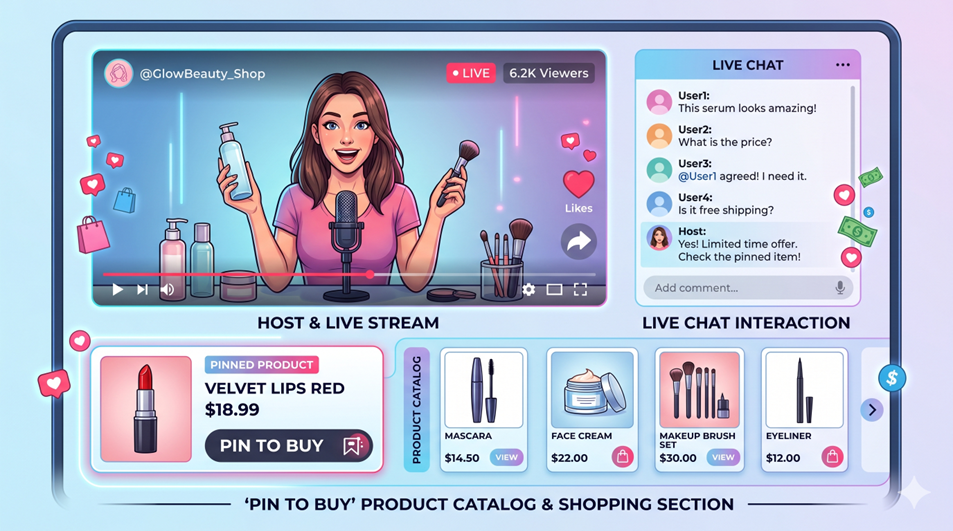
During a TikTok Live session, a host (often an influencer or a brand representative) showcases products in real-time. Viewers can interact through a live chat window, asking the host to demonstrate specific features—for example, asking them to swatch a different shade of lipstick or to show the inside pockets of a backpack. The host can respond to these requests instantly. This creates a highly interactive, personalized, and engaging Customer Experience that mimics the benefits of in-store physical shopping, but on a massive, digital scale.
From a psychological perspective, Live Commerce introduces the element of FOMO (Fear Of Missing Out), which drives conversion. Live streams often feature limited-time discounts or exclusive product drops that are only available while the broadcast is active. This creates a sense of urgency. While this urgency is excellent for driving sales, CX managers must handle it carefully. If the customer feels overly pressured, or if the product quality does not match the hype generated during the live stream, it can lead to buyer’s remorse, high return rates, and a damaged brand reputation. Therefore, maintaining transparency and delivering genuine value during live events is crucial for long-term customer satisfaction.
6. Strategic Implications for the Polish Market
The introduction of TikTok Shop in Poland presents unique opportunities and challenges for local e-commerce management. Polish consumers are highly digitally literate and have strong expectations regarding e-commerce standards, largely shaped by the dominance of platforms like Allegro and the efficiency of logistical networks like InPost Paczkomaty. To succeed in this market, brands utilizing TikTok Shop must ensure that their back-end operational management matches their front-end marketing appeal.
A great viral video and a seamless checkout process will mean nothing if the delivery takes two weeks or if the return process is complicated. Customer Experience is an end-to-end journey. Brands must integrate their TikTok Shop dashboards with robust inventory management and local fulfillment centers. Furthermore, customer support must be adapted to the platform. If a customer buys a product on TikTok, they will likely seek support on TikTok—via direct messages or video comments. Modern organizations must employ social media community managers who are trained not just in marketing, but in resolving complex customer service issues quickly and empathetically.
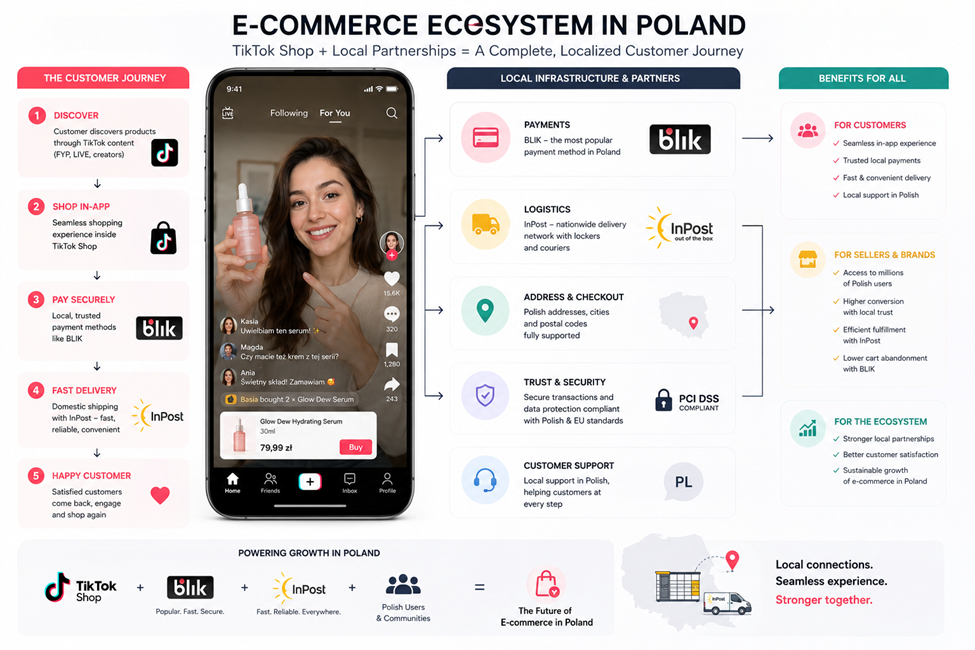
Additionally, brands must be highly aware of cultural nuances. The content that works for TikTok Shop in Asia or the US may not resonate with the Polish audience. Localization is key. Collaborating with local Polish creators, participating in local internet trends, and understanding the specific purchasing behaviors of the Polish Gen Z and Millennial demographics are essential strategies for building a sustainable and profitable presence on the platform.
7. Conclusion: The Future of Customer Experience Management
In conclusion, TikTok Shop is not merely a new sales channel; it is a fundamental disruption to the established norms of Customer Experience Management. By collapsing the sales funnel into a single, native application, it removes friction and capitalizes on the emotional power of entertainment and community. It proves that the future of modern retail lies in omnichannel strategies, where content and commerce are indistinguishable from one another.
For students and future executives studying Customer Experience Management, the rise of TikTok Shop serves as a vital lesson. It demonstrates that customer satisfaction in the modern era requires agility, a deep understanding of digital culture, and a willingness to embrace creator-led ecosystems. The traditional, static e-commerce catalog is being replaced by the dynamic, infinite scroll. Brands that adapt to this environment, focusing on authentic engagement, seamless operations, and interactive live commerce, will thrive in the next generation of retail.
Ultimately, whether an organization is selling on a classic platform like Amazon or a cutting-edge social ecosystem like TikTok, the core principle of CX remains the same: put the customer at the center of the strategy. Understand their needs, respect their time by removing friction, and provide an experience that is not only functional, but genuinely delightful.
References / Bibliography
- Parasuraman, A., Zeithaml, V. A., & Berry, L. L. (1988). SERVQUAL: A Multiple-Item Scale for Measuring Consumer Perceptions of Service Quality. Journal of Retailing, 64(1), 12-40
- Lemon, K. N., & Verhoef, P. C. (2016). Understanding Customer Experience Throughout the Customer Journey. Journal of Marketing, 80(6), 69-96.
- Boston Consulting Group (BCG) & TikTok. (2022/2024). Shoppertainment: APAC’s Trillion-Dollar Opportunity. Shoppertainment: APAC’s Trillion–Dollar Opportunity
- Hodkinson, C. (2019). ‘Fear of Missing Out’ (FOMO) marketing appeals: A conceptual model. Journal of Marketing Communications, 25(1), 65-88. Fear of Missing Out'(FOMO) marketing appeals: A conceptual model