Blockchain Sustainability

Blockchain Sustainability Index
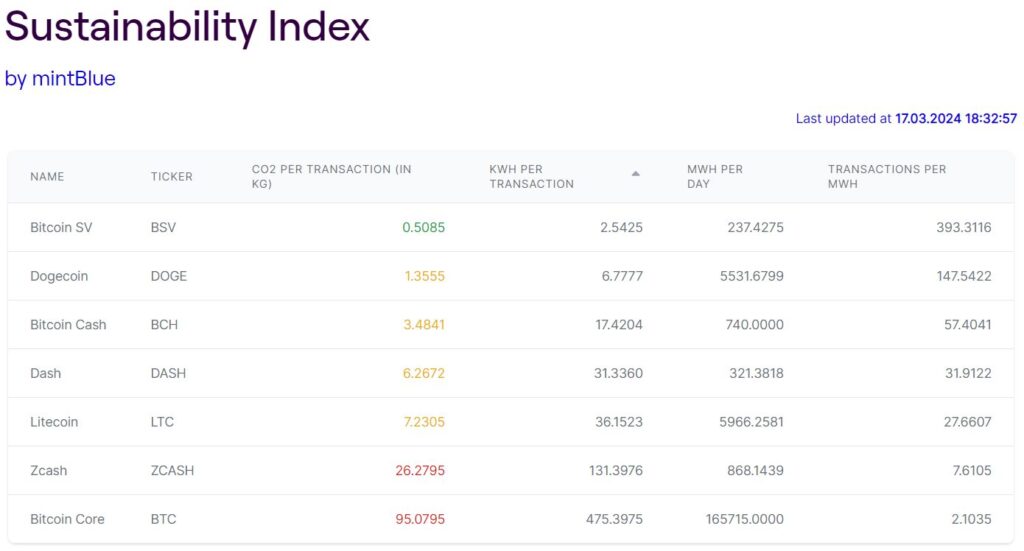
Traditional blockchain networks have a high carbon footprint by capping the throughput artificially.

mintBlue works with a network that follows economies of scale theory, whereas more transactions mean more efficient processing and a lower footprint and cost per transaction.

To calculate energy usage, the terahashes per second of a particular blockchain is divided by the terahashes per Watt of its most efficient miner. The resulting figure is then multiplied by 24 to determine energy consumption over a day. This value is divided by 1,000,000 to convert it to megawatt-hours (MWh).

BitInfoCharts

Similar Posts

  • Blockchain w Biznesie

    Blockchain w Biznesie – technologia blockchain, często kojarzona z kryptowalutami, a przeciez ma szerokie zastosowanie w różnych branżach. W tym wpisie omówimy podstawy, zalety i praktyczne zastosowania technologii blockchain, zgodnie z prezentacją “Blockchain w Biznesie”. Wprowadzenie do technologii Blockchain Blockchain to zdecentralizowany system, który działa bez centralnej władzy. Składa się z serii bloków, z których…

  • Blockchain w biznesie

    Blockchain w biznesie – blockchain technology has transcended its origins as the backbone of cryptocurrencies and has now permeated various industries, revolutionizing traditional business operations and unlocking unprecedented opportunities for innovation and efficiency. Across diverse sectors, from finance to healthcare, supply chain management to real estate, blockchain is being hailed as a transformative force. One…

  • Technologia blockchain w logistyce

    W dzisiejszym dynamicznym i globalnym środowisku biznesowym logistyka jest jednym z kluczowych elementów zapewniającym płynną i efektywną działalność przedsiębiorstw. Sprawny przepływ towarów, od producentów do klientów, to zasadniczy aspekt prowadzący do sukcesu przedsiębiorstwa na rynku. Osiągnięcie tego związane jest ze skomplikowanym zarządzaniem łańcucha dostaw, które wymaga nie tylko doskonałej organizacji, ale także szybkości, precyzji i…

  • Zero-Knowledge Proof

    Zero-knowledge proof refers to cryptographic methods that allow one party (the prover) to demonstrate to another party (the verifier) that a statement is true without revealing any additional information beyond the fact that the statement is true. In the context of blockchain transactions, like those on Zcash, this is primarily achieved using a specific type…

  • Blockchain in Retailing

    Blockchain in retailing as a distributed ledger technology gives retailers and consumers security, automation, inventory visibility, and transparency across the supply chain (SC). As an immutable ledger, Blockchain Technology (BT) can provide retailers with real-time data about their SC, leading to a more compliant SC. Given the importance of gaining customers’ trust, BT can provide…