
Virtual Idols: Why Digital Faces Sell Real Products
Virtual idols or influencers are computer-generated characters that run social media accounts, gain followers and promote brands, just like human creators. Some of them, such as Lil Miquela or Lu do Magalu, have millions of fans. In this post you will learn what virtual influencers are, why consumers form emotional bonds with them, and what two recent studies (2025 and 2026) tell us about when they help a brand and when they hurt it. We will also calculate two simple research metrics in Python.
After reading, you will be able to:
- define a virtual influencer and a virtual idol,
- explain para-social interaction and the uncanny valley,
- describe how facial realism, attractiveness and familiarity change brand attitude,
- read basic results from a PLS-SEM study and an experiment.
What are virtual influencers?
A virtual influencer (VI) is a digital character created with computer graphics (CGI) or generative AI. It has a name, a personality and a social media profile. A team of designers, writers and marketers stands behind it. The character posts content, talks to followers and signs brand deals.
In Asia, a closely related term is virtual idol. Yu, Bannasilp and Kwong (2025) define a virtual idol by three elements:
- Digital entity – it exists only as data, not as a living person.
- Anthropomorphic appearance – it looks human-like (anthropomorphism means giving human traits to non-human things).
- Idol activity engagement – it performs like a celebrity: sings, streams, gives concerts, endorses brands.
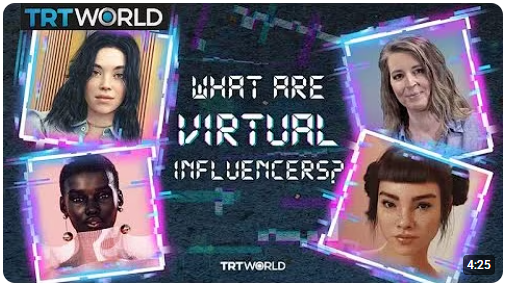
Virtual idols started in Japan in the 1990s. The best-known one is Hatsune Miku, a singing voice software character from Crypton Future Media (2007) who now fills concert halls with hologram shows.
Types of virtual influencers
| Type | Look | Example | Business use |
|---|---|---|---|
| Anime / cartoon idol | Stylised, clearly artificial | Hatsune Miku, Luo Tianyi (China) | Concerts, food, telecom, car endorsements |
| Brand mascot avatar | 3D, friendly, semi-realistic | Lu do Magalu (Magazine Luiza, Brazil) | Customer service, product reviews, e-commerce |
| Hyper-realistic CGI human | Almost photo-real | Lil Miquela (USA), Imma (Japan), Shudu | Fashion, beauty, tech campaigns |
| AI-generated model | Photo-real, made with generative AI | Aitana López (Spain) | Fitness, lifestyle, paid content |
Real business cases of virtual influencers
- Lu do Magalu (Magazine Luiza, Brazil). Lu was created in 2003 as a shopping assistant for the retailer’s website. Today she is a full brand personality. In 2022 the ranking site Virtual Humans named her the most-followed virtual influencer in the world, with about 55 million followers across platforms (Forbes Brasil, 2022). This is a classic case of a company owning its influencer.
- Lil Miquela (USA). Launched in 2016 by the start-up Brud, Miquela has worked with fashion brands such as Prada and Calvin Klein and was signed by the talent agency CAA (Wikipedia).
- Aitana López (Spain). Created by the Barcelona agency The Clueless, she gained over 340,000 Instagram followers in about 18 months. Her creators say she earns around €3,000 a month, and up to €10,000 in good months (Euronews, 2024).
- Luo Tianyi (China). A virtual singer with 5.4 million Weibo followers. Her endorsements cover food, telecoms, insurance, banking and cars (Yu et al., 2025).
Why do brands like them? Human celebrities are expensive and can cause scandals. A virtual influencer never gets tired, never ages and never posts something embarrassing at 3 a.m. – the brand controls every word (Moustakas et al., 2020, cited in Xian et al., 2026). The market is large: iiMedia Research estimates that industries driven by virtual humans in China will reach 640 billion RMB in 2025 (cited in both papers).
Study 1: Virtual idols and para-social interaction
The first paper is “Virtual Idols’ influence on consumer’s brand attitude and purchase intention: A perspective of para-social interaction” by Yu, Bannasilp and Kwong, published in Electronic Commerce Research and Applications (2025).
Key term: para-social interaction (PSI)
Para-social interaction is a one-sided relationship. A fan feels that they know a media figure personally, like a friend, but the figure does not know the fan. You might feel this way about a YouTuber you watch every day. The study asks: can people build such a bond with a character who is not even human?
Method
The authors surveyed 418 fans of virtual idols on Chinese platforms (Weibo, Bilibili, Baidu Post Bar). 92.6% were Generation Z (aged 12–27). They used PLS-SEM (Partial Least Squares Structural Equation Modelling) – a statistical method that tests many cause-and-effect paths between hidden concepts (like “attractiveness”) measured by survey questions.
Results
Four features of a virtual idol build para-social interaction. The number β (beta) shows the strength of each path: higher means stronger.
| Path | β | Meaning |
|---|---|---|
| Homophily → PSI | 0.341 | Fans feel the idol shares their attitudes and morals (strongest driver) |
| Social attractiveness → PSI | 0.259 | The idol seems likeable, a potential friend |
| Activity → PSI | 0.206 | The idol posts, streams and performs often |
| Physical attractiveness → PSI | 0.125 | Good looks matter, but least |
| PSI → Brand attitude | 0.457 | Strong effect |
| PSI → Purchase intention | 0.150 | Weak direct effect |
Homophily means “love of the same” – we like people who are similar to us. The lesson is surprising: values matter more than looks.
The second big finding is about mediation. A mediator is a variable that carries an effect from A to C. Here, PSI affects purchase intention mostly through brand attitude. Fans know a virtual idol does not really use the product. So the idol does not convince them to buy directly; instead, their affection transfers to the brand (affect transfer), and a better brand attitude leads to buying. The authors’ advice: make brand attitude, not immediate sales, the main goal of a virtual idol campaign.
Python: decomposing the total effect
The indirect effect equals the product of two paths (a × b). The paper reports total = 0.467 and indirect = 0.317. Let us check what share of the effect goes through brand attitude.
# Yu et al. (2025) - mediation decomposition
a = 0.457          # PSI -> brand attitude
indirect = 0.317   # PSI -> brand attitude -> purchase intention
direct = 0.150     # PSI -> purchase intention

b = indirect / a   # implied path brand attitude -> purchase intention
total = direct + indirect
share = indirect / total

print(f"Implied b path: {b:.3f}")          # 0.694
print(f"Total effect:   {total:.3f}")      # 0.467
print(f"Mediated share: {share:.0%}")      # 68%
About two-thirds of the influence goes through brand attitude. This number is called the variance accounted for (VAF), and it is a common way to describe partial mediation.
Study 2: Virtual influencers, facial realism and the uncanny valley
The second paper is “Beyond the uncanny valley: the dual pathways of virtual influencers’ facial realism on brand attitude” by Xian, Zhang, Liu, Huang and Zhang, also in Electronic Commerce Research and Applications (2026). It asks a design question: how human should a virtual influencer’s face look?
Key terms
- Uncanny valley – a theory by robotics professor Masahiro Mori (1970). As a robot or avatar looks more human, we like it more, until it looks almost human. Then small errors (dead eyes, plastic skin) make it feel creepy. Liking drops into a “valley”.
- Eeriness – the creepy, uncomfortable feeling the uncanny valley produces.
- Meaning transfer theory – Grant McCracken’s (1989) idea that the cultural meanings of an endorser (e.g. “cool”, “luxurious”) move to the brand they endorse.
- Coolness – being seen as unique, trendy and attractive in a slightly rebellious way.
Method: four experiments
The authors ran four online experiments with Chinese consumers (N = 298, 289, 253 and 247). Participants saw an ad for a fictitious tech product (phone, headphones, laptop) endorsed by a virtual influencer with a high- or low-realism face. In an experiment, people are randomly assigned to groups, so differences between groups can be read as causal effects – something a survey cannot prove.
Results: two pathways
- Main effect. A realistic face improved brand attitude a lot: 5.07 vs. 3.87 on a 7-point scale (Study 1).
- Positive “coolness” path. A realistic VI looks cooler → the brand looks cooler → brand attitude rises. This is meaning transfer in action.
- Negative “eeriness” path. A low-realism face felt eerie, and eeriness lowered brand attitude directly. It did not work through brand authenticity, as the authors expected. Eeriness is a fast gut reaction, not a rational judgement.
Boundary conditions: attractiveness and familiarity
A boundary condition (moderator) changes the strength of an effect.
| Moderator | Brand attitude: low vs. high realism | What it means |
|---|---|---|
| Low attractiveness | 2.67 → 4.86 (gap 2.19) | Realism is critical for a plain face |
| High attractiveness | 3.98 → 5.05 (gap 1.07) | Beauty works as a “halo” and buffers low realism |
| Low familiarity | 4.86 → 5.22 (gap 0.36) | Realism matters little for a new face |
| High familiarity | 4.85 → 5.88 (gap 1.03) | A face that resembles a known person is scrutinised closely |
Two lessons stand out. First, the halo effect – our tendency to assume that beautiful people are also good in other ways – partly protects an imperfect face. But beauty did not remove eeriness. A pretty but “wrong” face can still feel creepy. Second, the familiarity result was the opposite of the hypothesis. If a VI’s face is modelled on a famous person, consumers study it carefully. Perfect execution is rewarded; weak execution is punished.
Python: effect size (Cohen’s d)
Cohen’s d tells us how big a difference between two groups is, in standard deviations. Rules of thumb: 0.2 small, 0.5 medium, 0.8 large.
import math

# Xian et al. (2026), Study 1: brand attitude
m_high, sd_high = 5.07, 1.19   # high facial realism
m_low,  sd_low  = 3.87, 1.46   # low facial realism

pooled_sd = math.sqrt((sd_high**2 + sd_low**2) / 2)
d = (m_high - m_low) / pooled_sd
print(f"Cohen's d = {d:.2f}")   # about 0.90 -> large effect
Our result (0.90) matches the paper’s reported d = 0.901. Facial realism is not a cosmetic detail; it has a large effect.
What do the two studies mean for marketers?
- Choose values before looks. Homophily was the strongest driver of fan bonds. Give the character a clear personality and values that match your target group.
- Keep it active. Regular posts, live streams and replies to fans build para-social interaction.
- Measure brand attitude, not only clicks. Virtual influencers work mainly through attitude. Use brand-lift surveys, sentiment analysis and long-term KPIs, not just last-click sales.
- Go fully realistic or clearly stylised. The danger zone is the middle. Invest in skin texture and eye details, or choose an openly cartoon style like Hatsune Miku.
- Be careful with look-alikes. A VI based on a famous face raises expectations.
- Be transparent. Label AI-generated content and sponsored posts. The EU AI Act and consumer-protection rules increasingly require it.
Limitations to remember
Both studies used Chinese samples, so culture may shape the results. Study 1 used self-reported survey data from fans who already liked virtual idols. Study 2 used fictitious tech brands only. Results may differ for food, fashion or utilitarian products.
Essay topics for students
- Virtual influencers in Polish e-commerce: Could a brand like Allegro, InPost or Reserved build its own “Lu do Magalu”? Design the persona and a KPI plan.
- Ethics of virtual influencers: Should AI-generated influencers be labelled? Discuss transparency, body-image pressure and the EU AI Act.
Related reading on this blog: AI influencers · Authenticity in Influencer Marketing · TikTok Shop and customer experience · Customer Journey in the Age of AI
Summary: three key questions
1. What are virtual influencers and why do brands use them?
They are computer-generated characters that act as social media creators and brand endorsers. Brands use them because they are fully controllable, scandal-free, always available and attractive to Generation Z.
2. How do virtual influencers influence consumers?
Through para-social interaction: fans form a one-sided emotional bond, driven mostly by perceived similarity in values (homophily), social attractiveness and activity. This bond improves brand attitude strongly (β = 0.457), and brand attitude then drives purchase intention (Yu et al., 2025).
3. Why does facial realism matter?
A realistic face transfers “coolness” to the brand, while an almost-but-not-quite human face triggers eeriness (the uncanny valley) that directly lowers brand attitude. High attractiveness softens this effect; a familiar face makes consumers more critical (Xian et al., 2026).
Sources
- Yu, Y., Bannasilp, A., & Kwong, S. C. M. (2025). Virtual Idols’ influence on consumer’s brand attitude and purchase intention: A perspective of para-social interaction. Electronic Commerce Research and Applications, 74, 101546. https://doi.org/10.1016/j.elerap.2025.101546
- Xian, X., Zhang, Y., Liu, R., Huang, C., & Zhang, L. (2026). Beyond the uncanny valley: the dual pathways of virtual influencers’ facial realism on brand attitude. Electronic Commerce Research and Applications, 79, 101628. https://doi.org/10.1016/j.elerap.2026.101628
- Forbes Brasil (2022). Por que a Lu do Magalu tornou-se a maior influenciadora virtual do mundo.
- Euronews (2024). Meet the first Spanish AI model earning up to €10,000 per month.
- Wikipedia. Miquela.
- McCracken, G. (1989). Who is the celebrity endorser? Cultural foundations of the endorsement process. Journal of Consumer Research, 16(3), 310–321.
- Mori, M., MacDorman, K. F., & Kageki, N. (2012). The uncanny valley. IEEE Robotics & Automation Magazine, 19(2), 98–100.