ServQual methodology for assessing the usability of automated sales in grocery
SERVQUAL jest to metoda, gdzie za pomocą wielostopniowej skali dokonuje się pomiaru jakości
usług przez pryzmat postrzegania klienta. Otrzymane wyniki dają wartościowe wskazówki,
odnośnie do ulepszania jakości usług (Wolniak, Skotnicka-Zasadzień, 2009).
SERVQUAL jest metodą wieloaspektową, z której można skorzystać przy rozpatrywaniu całego systemu usługowego lub pojedynczych jego elementów (Urbaniak, 2013). Zakres zastosowania tej metody jest bardzo szeroki, czego dowodzą liczne publikacje z tego zakresu (Czajkowska,
Ingladi, 2021, Chmielewski, 2008, Wolniak, 2010, Wolniak, Skotnicka-Zasadzień, 2009). W
metodzie tej przewiduje się, że klienci, podczas oceny jakości usług, uwzględniają wiele wyróżników, do których należą m.in.:
Parasuraman [6] mentioned that the satisfaction of customer was the gaps measurement between expected and perceived service received by customers, defined as customer gaps. Moreover, another gap was also measured for mining the causes of customer gaps, and all those integrated gaps were summarized as the well-known method called SERVQUAL which stands for service quality. https://iopscience.iop.org/article/10.1088/1757-899X/245/1/012029/pdf
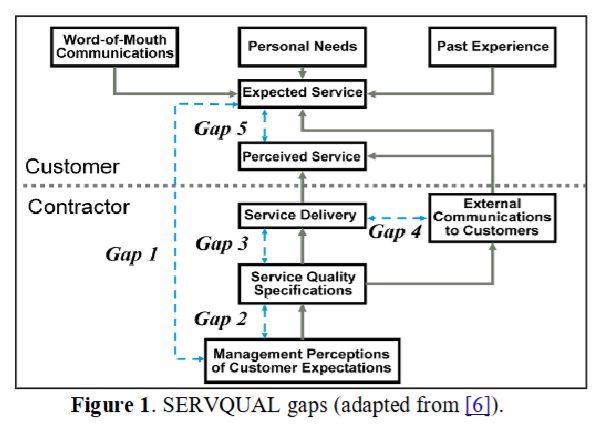
Common questionnaires for measuring these customer gaps consist of at least 20 Likert scale questions. All items are generated based on 5 dimensions i.e. tangibles, empathy, reliability, responsiveness, and assurance. The overall satisfaction score of a customer is calculated as the average of each item scores.
Commonly, the satisfaction level of a customer is related with how long he has been using the service. The longer using the service then the satisfaction level usually decreased, as mentioned in [8]. Meanwhile, since each customer has different satisfaction level variation over time, so there will be two random variables affecting the life-cycle of service, that are a) the satisfaction level (measured using questionnaire) and B) how long a customer has been using the service (measured in time).
niezawodność, kompetentność, odpowiedzialność, uczynność, materialna obudowa usługi, zaufanie, poczucie bezpieczeństwa, komunikatywność, osiągalność i zrozumienie klienta
(Rudawska, Kiecko, 2000)
Autorzy metody SERVQUAL (Parasuraman, Zeithaml, Berry, 1988) znaleźli pięć luk, które są przyczyną powstawania niezadowolenie klienta i powodują niewysoką ocenę jakości świadczonych usług. Pięć luk to różnice pomiędzy jakością spodziewaną i otrzymywaną. W sytuacji, kiedy nie występują żadne luki (rozbieżności), można mówić o wysokiej jakości.

Ankieta SERVQUAL dotyczy tzw. piątej luki, która określa różnice pomiędzy usługą oczekiwaną a postrzeganą. Ankieta składa się z dwóch kwestionariuszy zawierających zazwyczaj 22 pytania, podzielone na pięć obszarów, odnoszące się do najważniejszych czynników decydujących o jakości świadczonych usług. Te pięć obszarów to:
elementy materialne usługi, niezawodność, szybkość reakcji, pewność i empatia
(Wolniak, Skotnicka, 2008)
Wiecej na temat tutaj
To create a survey using the ServQual methodology specifically for assessing the usability of automated sales in grocery, you can follow steps. Sevice quality is important in any business, but especialy in grocery story which would to be percived as socially responsible.
- Identify the five dimensions According to the ServQual framework – there are five dimensions of service quality – reliability, assurance, tangibility, empathy, and responsiveness.
- Here are the names of the ServQual dimensions in Polish:
- Rzetelność (Reliability)
- Pewność (Assurance)
- Namacalność (Tangibility)
- Empatia (Empathy)
- Reagowanie (Responsiveness)
- Customize these dimensions to fit the context of automated sales in grocery.
- Draft questions for each dimension. Create questions that focus on each dimension to gather feedback on the usability of automated sales in grocery. All question should be judget in Lickert scale 1-5 or 1-7.
- For example:

ServQual survey
- Reliability:
- Czy automaty do sprzedaży automatycznej są posiadają wszystkie potrzebne funkcje jak skaner, waga, czytnik kart płatniczych, miejsce na spakowanie zakupów i inne. Oceń w skali 1-5 jak oceniasz wyposażenie stanowisk automatycznej sprzedaży, gdzie 1-bardzo słabe, 5-bez zarzutu.
- How often do you experience issues or errors while using automated sales in grocery?
- Jak czesto musisz korzystać z pomocy personelu. Ocen w skali 1-5 jakim stopniu stnowi to dla ciebie problem, 1=duży problem, dyskwalifikujący, 5=żaden problem
- Assurance:
- Do you feel confident that your transactions are secure when using automated sales in grocery?
- Jak oceniasz zliczanie produktów, czy obawiasz się, że automat wykryje niezgodności i zatrzyma skanowanie. 1-tak, bardzo obawiam się tego, 5-nie nie stanowi to dla mnie problemu
- Jak oceniasz wybieranie produktów z list na ekranie, czy obawiasz się, że czegoś nie znajdziesz i zatrzymasz cały proces. 1-tak, obawiam się tego bardzo, 5-nie stresuje mnie to.
- Tangibility:
- How visually appealing and functional do you find the user interface of automated sales in grocery?
- Czy automaty wyglądają zachęcająco do skorzystania z ich “usług”? 1-nie, są przerażające, 5-tak, wyglądają zachęcająco.
- Czy miejsce gdzie automaty są ustawione daje możliwości dokupywwania produktów czy swobodnego poruszania się, 1-Nie, jest ciasno i technicznie, 5-tak, jest wygodnie i swojsko.
- Empathy:
- Do you feel that the automated sales in grocery understand your needs?
- Czy automaty są dostosowane do tego jak ludzie chcieliby zakończyć swoje zakupy przy tego typu kasie, 1-Nie, sa techniczne i bezduszne, 5-tak, sa wygodne i bez zarzutu
- Czy automaty podpowiadają jak pokonać daną trudność i jest to skuteczne? 1-Nie, nie podpowiadją, blokuja się i musimy czekać na obsługę, 5-Podpowiedzi są jasne i szybko prowadzą do kontynuacji zakupów.
- Responsiveness:
- How quickly do the automated sales in grocery address any issues or concerns you may have?
- Czy problemy ze skanowaniem produktu, wagą lub wyszukiwaniem sa szybko wykrywane i pojawia się podpowiedź adekwatna do sytuacji i w czasie kiedy jej oczekujesz? 1-Nie, zbyt szybko lub nie pojawia się, 5-adekwatnie i doskonale
- Czy reakcja personelu pomocniczego jest adekwatna czy pełna wyrzutu? 1-Nieprzyjemna i pełna wyrzutu, 5-pomocna i adekwatna
ServQual framework for measure quality of selection and order placing in fast food chains
Here’s a proposed set of two questions per dimension for measuring the quality of automated product selection and order placing in fast food chains like McDonald’s or KFC using the ServQual framework:
- Rzetelność (Reliability):
- How often have you experienced errors or discrepancies in your order when using the automated product selection and order placing system?
- To what extent do you trust the accuracy of the order placed through the automated system at fast food chains like McDonald’s or KFC?
- Pewność (Assurance):
- Do you feel confident that the automated system at fast food chains like McDonald’s or KFC will process your order correctly and timely?
- How well-trained do you think the employees of these fast food chains are at handling and resolving any issues related to the automated product selection and order placing system?
- Namacalność (Tangibility):
- How visually appealing and user-friendly do you find the interface of the automated product selection and order placing system at fast food chains like McDonald’s or KFC?
- How satisfied are you with the physical setup and appearance of the kiosks or terminals used for automated order placing in fast food chains like McDonald’s or KFC?
- Empatia (Empathy):
- To what extent do you feel that the automated system understands and meets your specific preferences and customization options for your order?
- How satisfied are you with the level of personalized recommendations or suggestions provided by the automated product selection and order placing system in fast food chains like McDonald’s or KFC?
- Reagowanie (Responsiveness):
- How quickly and efficiently are any issues or concerns addressed by the staff when using the automated product selection and order placing system at fast food chains like McDonald’s or KFC?
- How satisfied are you with the overall responsiveness of the automated system to any changes or modifications requested during the order placement process?
Remember to adapt these questions based on the specific context and target audience. Additionally, consider including demographic questions to gather information about age, frequency of visits, or previous experience with the automated system to help analyze the results effectively.
Ending note
- Design the survey structure: Decide on the format of your survey, such as multiple-choice, rating scales, or open-ended questions. Consider using a combination of these formats to capture a comprehensive understanding of users’ experiences.
- Include demographic questions: To gain insights into the respondents’ backgrounds, add some demographic questions, such as age, gender, frequency of grocery shopping, etc. This information could help to identify potential patterns or differences in responses.
- Test the survey: Before launching the survey, conduct a trial run to ensure that the questions are clear, concise, and unbiased. Ask a few individuals to complete the survey and provide feedback on the clarity and relevance of the questions.
- Collect and analyze the data: Once the survey is completed by a sufficient number of respondents, collect and analyze the data. Use statistical analysis methods to identify patterns and trends in the responses.
- Interpret the results: Evaluate the survey results in the context of each dimension and overall usability. Determine areas of strengths and weaknesses in automated sales in grocery and prioritize improvement actions based on the feedback.
Remember to keep the survey concise, limit jargon, and avoid leading or biased questions to maintain the accuracy and integrity of the data collected.