Customer Journey In The Age of IA
Customer journey is an iterative, dynamic, and cyclic purchasing process that consists of prepurchase, purchase, and post-purchase stages (Lemon & Verhoef, 2016). In short, a customer journey begins with the pre-purchase stage involving the need recognition, information search, and decision-making.
It continues through the purchase stage where the need is fulfilled, and concludes with the post-purchase stage that encompasses feedback and evaluation of the experience (Fuller et al., 2023).
As the first two stages (pre-purchase and purchase) are often difficult to be distinguished from each other due to their overlapping nature, the transaction typically serves as the point of separation (Lemon & Verhoef, 2016).
Throughout the customer journey, customers encounter various touchpoints, which are the points of interaction between a customer and a brand (Følstad, & Kvale, 2018). These touchpoints along the customer journey can be both customer-driven or brand-driven (Barann et al., 2022; Payne et al., 2017).
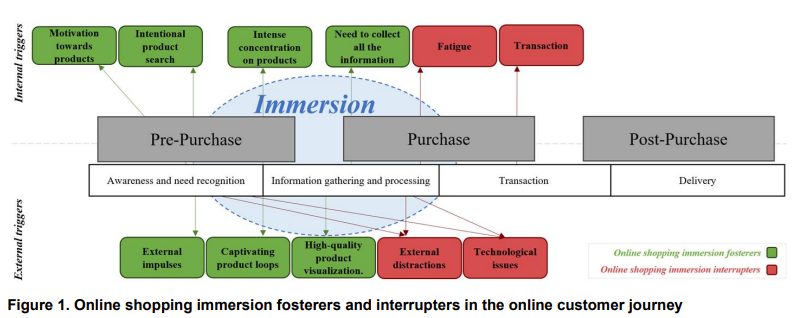
Source: Kaleton, T., Holkkola, M., Kemppainen, T., & Frank, L. (2026). What Makes or Breaks an Immersive Online Customer Journey? Digital Native Generation Z Customers’ Experiences: Link.
Customer journeys may be enhanced by immersion both directly and indirectly (Flavían et al.,
2024). During their customer journeys, customers are seeking highly customizable experiences, where they
can efficiently view products from various angles and engage interactively with a brand (Neves et al., 2022).
For example, high-quality product photos on online stores allow customers to visualize the products and
imagine them in different situations. If customers are provided with sufficient information, they can make
informed purchasing decisions (Flavián et al., 2019).
Thus, immersivity has great possibilities for retailing companies in digital environments. However, VR and
AR solutions related to clothing retail are yet in their early stages and, thus, not largely available in online
stores or applications (Solís-Sánchez et al., 2022).