
What is digital age?
What is digital age? The digital age, also known as the information age. It is a historical period, beginning with the advent of computers in the 1960s and continuing to the present days. The period is characterized by rapid increases in the electronic processing and sharing of information. The digital age is enabled by four technologies – computer hardware, software applications, internet and mobile communications, and artificial intelligence.
These technologies have drastically reduced the costs of access to information, including storing data, organizing, searching for, analyzing and finally sharing information. It was been enhanced by universal and public access to the internet and the application of mobile technology on worldwide scale. What is digital age?
Post is based on the article: Corporate Strategy and the Theory of the Firm in the Digital Age, Markus Menza, Sven Kunisch, Julian Birkinshawc, David J. Collisd, Nicolai J. Fosse, Robert E. Hoskissonf and John E. Prescottg
University of Geneva; Aarhus University; London Business School; Harvard University; Copenhagen
Business School; Rice University; g University of Pittsburgh. Journal of Management Studies 58:7 November 2021, doi:10.1111/joms.12760.
What is digital age? New business models
Digitalization has affected the pursuit (chase, hunt, coursing) of corporate competitive advantage in
a number of complex ways. We focus on two here, 1) the increasing variety of corporate business models and 2) the shift from value capture to value creation.
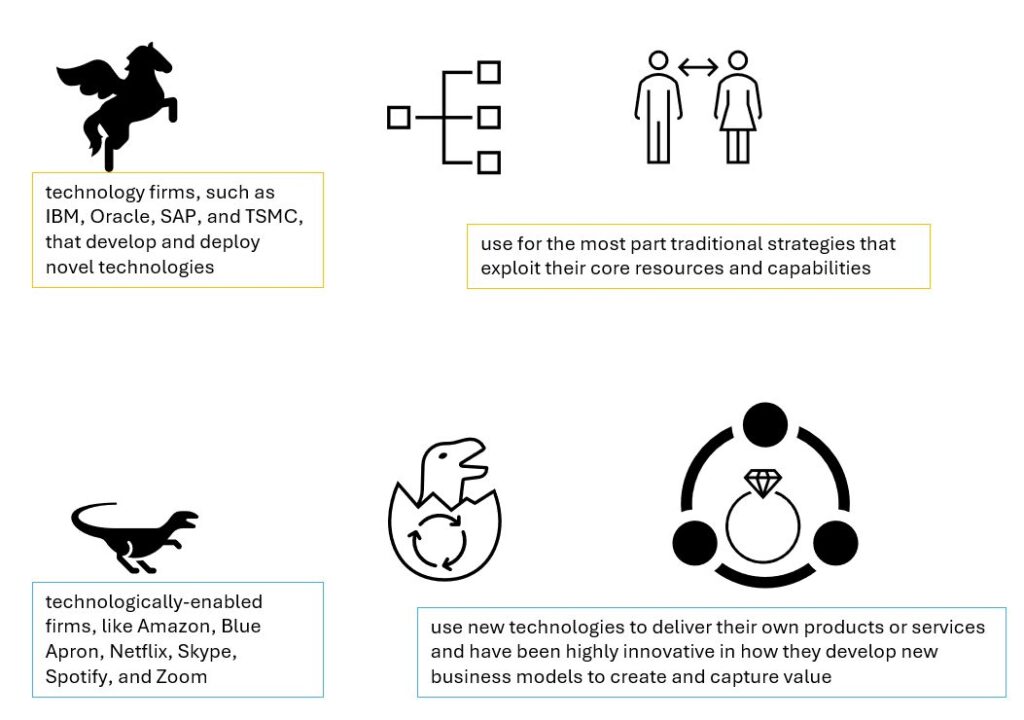
Digitalization has created two different types of firms: a) some are technology firms, such as IBM, Oracle, SAP, and TSMC, that develop and deploy novel technologies and use for the most part traditional strategies that exploit their core resources and capabilities and b) others are technologically-enabled firms, like Amazon, Blue Apron, Netflix, Skype, Spotify, and Zoom, which use new technologies to deliver their own products or services and have been highly innovative in how they develop new business models to create and capture value.
The digital age has enabled the emergence of a business landscape very different from the industrial age. Due to the access to information and finally knowledge become cheap and easy, this gives a strong incentive to building market share notably through exploiting network externalities. Traditional thinking about competitive strategy based on Porter’s (1980, 1985) standards become obsolete. Digital markets have strong network effects, and therefore twist (turn, veer) towards winner-takes all scenarios. They therefore involve a different set of responses from competitors and regulators.
Moreover, the vast improvements in operational efficiency made possible through information technology (IT) investments have not been achieved consistently across all firms. Firms that are ‘born digital’ are often an order of magnitude more efficient than traditional firms which operate with a legacy physical infrastructure. For example, Amazon has created a massive shift to online sales from physical retailers such as JCPenney and Macy’s. Indeed, hardly any of today’s unicorn companies could exist without the access
to data and some form of digital technology that supports a profusion of business models based on those resources rather than traditional fixed assets.
However, a more sophisticated understanding of network effects recognizes that only if there are high switching costs, homogeneous consumers and the absence of multi-homing will there be a ‘winner-take-all’. Notably, these conditions are not always met as, for example, could be observed in the case of MySpace losing out to Facebook. More generally, connected actors in a digital world become complementors as their products or services increase the value of, or demand for those of another firm.
What is digital age? In this market structure, interaction among players introduces the paradox of ‘coopetition’, as firms cooperate with each other to increase the size of the pie, but compete over the size of the pie. For example, competition among standards, which pitches one group of firms against another, makes firm strategies interdependent, such as by establishing an ecosystem, in a way that traditional strategic ‘positioning’ considerations do not take into account.
While the effect of the digital age in business-to-consumer (B2C) markets is highly visible, a comparable level of change is also occurring behind-the-scenes in business-to-business (B2B) markets. For example, manufacturing firms now employ countless sensors and numerical controllers in their plants enabling automation of many tasks, predictive maintenance of machines, and continuous improvement in their performance without any human interference. Digital twins of factories now exist, while the interaction with
novel physical technologies, like 3D printing (D’Aveni, 2013), further enhances productivity. Combined with machine learning and AI, digitalization now allows a machine to beat every human player at chess and Go games, and drives efficiencies in activities as varied as domestic electricity consumption to train scheduling.
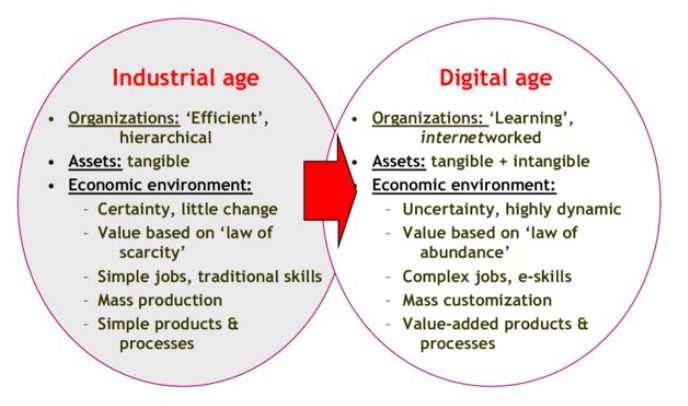
In sum, digital technologies have led to drastic changes in the nature of firms, competition, and industries and markets. These changes in the digital age affect how multi-business firms can gain a corporate (competitive) advantage and add value through their corporate strategies, as we discuss in detail below.
Indeed, one of the frequently-cited (economic) consequences of the digital revolution has been a ‘shake-up’ in the list of the most valuable companies in terms of market capitalization. In 1980, only two ‘tech’
companies, IBM and AT&T were among the ten most valuable firms, alongside GE, Exxon and a range of other industrials. On 31 March 2021 the top ten list featured seven digital firms, Apple, Microsoft, Amazon, Alphabet, Facebook, Tencent, and Alibaba, the first four each with a market value of more than USD 1 trillion. What is digital age?
We acknowledge that other ‘revolutions’ are occurring alongside the transition to a digital age, including the energy transition away from hydrocarbons, and the rapid transformation of bioscience and genetics and of the resulting market convergence (Hsu and Prescott, 2017).
The impact of digital technology is enhanced by its interaction with developments in fields such as nanoscience. In addition, the volume, reach, rate, and cost of physical communication went through dramatic improvements before their digital counterparts. In
the fifty years since containerization, for example, transportation costs, as a percentage of the value of goods shipped, nearly halved (Hummels, 2007). Therefore, the changes and benefits we observe today are not exclusively due to digitization because the cost and volume of both physical and virtual interactions have shifted exponentially in the last decades.
Read about customer experience in digital edge in: Customer Experience Management in the Digital Age
What is digital age?
The “digital age” as a managerial concept refers to the fundamental transformation in management practices, leadership roles, and organizational operations driven by rapid technological advancements and digitalization. It marks a shift from traditional, hierarchical, and siloed management approaches to more dynamic, agile, and technology-enabled ways of leading and governing organizations.
What is digital age? – in Management concept
1. Shift in Management Approach
Management in the digital age emphasizes agility, adaptability, and continuous learning. Traditional management focused mainly on supervising employees, setting goals, and optimizing internal operations. In contrast, digital-age management requires leaders to be flexible, open to change, and capable of quickly adapting strategies in response to emerging technologies and market trends12.
2. Technology Integration
Managers must leverage digital tools such as data analytics, artificial intelligence (AI), cloud computing, and collaboration platforms to enhance decision-making, communication, and operational efficiency. Automation of routine tasks frees managers to focus on strategic initiatives, while real-time performance monitoring and data-driven insights improve responsiveness and productivity23.
3. Organizational Structure and Culture
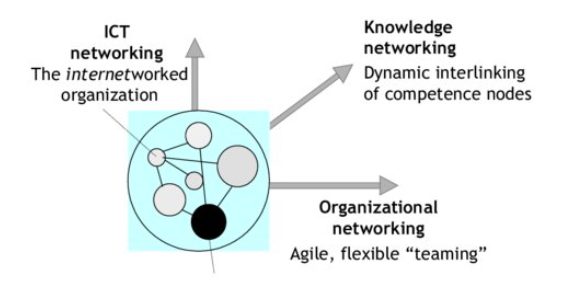
The digital age fosters flatter, more flexible organizational models that encourage collaboration and innovation. Remote work and virtual teams have become widespread, requiring managers to develop skills in leading dispersed teams, maintaining engagement, and ensuring effective communication across digital channels24.
4. Leadership Evolution
Digital leadership blends traditional leadership skills with digital fluency. Effective digital leaders demonstrate adaptability, emotional intelligence, data literacy, and a collaborative mindset. They balance technology use with a human-centered approach, prioritizing employee well-being and fostering trust and morale in increasingly virtual environments35.
5. Lifelong Learning and Disruption Preparedness
Managers and leaders in the digital age must continuously scan the technological horizon, embrace lifelong learning, and prepare their organizations for ongoing disruption. This includes cultivating a culture of innovation and equipping teams with the skills needed to navigate rapid changes in the digital landscape6.
6. Decision-Making and Autonomy
With more autonomous and remote work settings, effective decision-making becomes critical. Managers must empower employees to take responsibility and make timely decisions, overcoming reluctance and fostering accountability in a digital work environment7.
Summary
What is digital age? The digital age as a managerial concept encompasses a comprehensive transformation where technology reshapes how organizations are led and managed. It requires a shift toward agile, data-driven, and human-centric leadership that leverages digital tools to enhance collaboration, innovation, and resilience. Managers must adapt to new organizational structures, embrace continuous learning, and develop competencies to lead effectively in a fast-evolving digital world1236.