Advanced Programming in Data Analysis
Advanced Programming in Data Analysis in data-driven world has got a new meanning. Advanced programming skills are essential for effective data analysis. This blog post explores the key concepts and techniques covered in the first part of the course “Zaawansowane programowanie w analizie danych,” led by Dr. Mieczysław Pawłowski from UMCS. We will delve into business analytics, data processing, and the tools and languages that are pivotal in modern data analysis.
Business Analytics
Business analytics involves a series of activities aimed at utilizing existing data to make fact-based decisions. It encompasses various skills, methods, and tools to transform data into actionable insights. The results of these analyses are used by managers, clients, and other stakeholders to make informed decisions.
Types of Business Analytics
Business analytics can be categorized based on the purpose of information retrieval, its nature, and the methods used to obtain it. The main types include:
- Predictive Analytics: Focuses on modeling the future and forecasting outcomes.
- Prescriptive Analytics: Determines possible scenarios, options, and consequences of potential decisions.
- Diagnostic Analytics: Answers questions about the causes of phenomena or events based on historical data.
- Descriptive Analytics: Processes historical data to describe past events, results, and facts.
- Cognitive Analytics: Utilizes advanced AI and machine learning technologies.
- Big Data Analytics: Involves processing large volumes of data, often of an atypical nature, to support managerial decisions or automate decision-making.
The Analytical Process
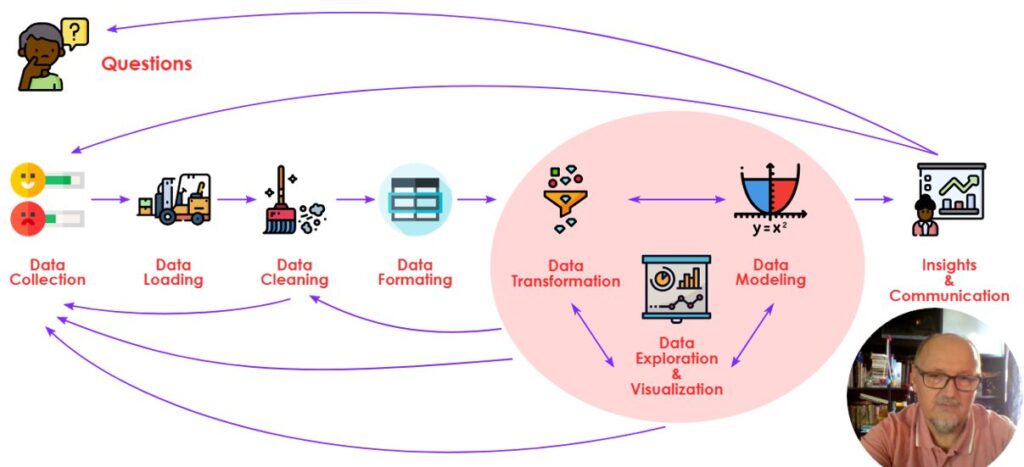
The analytical process involves several stages, from data acquisition to presentation. One of the most time-consuming tasks for analysts is data cleaning, often referred to as “Data Cleaning NINJA.” This process ensures that the data is accurate and ready for analysis.
Data Acquisition and Storage
Data can be sourced from various formats and systems, including:
- Files: txt, csv, pdf, xlsx, etc.
- Databases: ERP, CRM systems, MS SQL Server, MySQL, PostgreSQL, DB2, SAP HANA, MS Access.
- APIs: Accessing data through Application Programming Interfaces.
Data Analysis Tools
Several tools are essential for data analysis, including:
- Excel: Widely used for data manipulation and visualization.
- SQL: Crucial for querying and managing databases.
- Python: A versatile programming language for data analysis and automation.
- VBA: Used for automating tasks in Excel.
- Power BI: A powerful tool for creating reports and dashboards.
- Tableau: Another popular tool for data visualization.
Best Programming Languages for Data Science and Analytics
The course highlights several programming languages that are particularly useful for data science and analytics:
- Python: Known for its simplicity and extensive libraries.
- SQL: Essential for database management.
- R: Popular for statistical analysis.
- VBA: Useful for automating Excel tasks.
- Java: Known for its robustness and scalability.
- Julia: Gaining popularity for its performance in numerical computing.
Python for Data Analysts
Python is a fundamental programming language for data analysts. The course covers various aspects of Python, including:
- Python Fundamentals: Basic elements of the language, functions, loops, and control structures.
- Key Libraries: Pandas, NumPy, SQLAlchemy, Datetime, Flask, etc.
- Python & Power BI/Excel: Integrating Python with BI tools for data processing and sharing.
- Creating Custom Libraries: Developing and utilizing custom libraries in projects.
- Automation: Automating scripts and reports.
- From Script to Application: Building web applications and GUIs.
Advanced programming in data analysis – practical applications
The course includes several practical projects, such as:
- Budgeting: Using data analysis for financial planning.
- Anomaly Detection: Identifying unusual patterns in data.
- Sales Forecasting: Predicting future sales trends.
- Recommendation Systems: Developing systems to suggest products or services.
Conclusion
Advanced programming in data analysis is crucial for transforming raw data into valuable insights. By mastering tools like Python, SQL, and Power BI, analysts can enhance their capabilities and contribute significantly to their organizations. This course provides a comprehensive foundation for anyone looking to excel in the field of data analysis.